
Continue reading below for a comprehensive explanation of Mendelow’s Matrix and how to categorise stakeholders. If you would like more on this and other MBA, business, finance, investing and marketing topics, keep an eye on the Books and Resources section on Mega Meerkat.
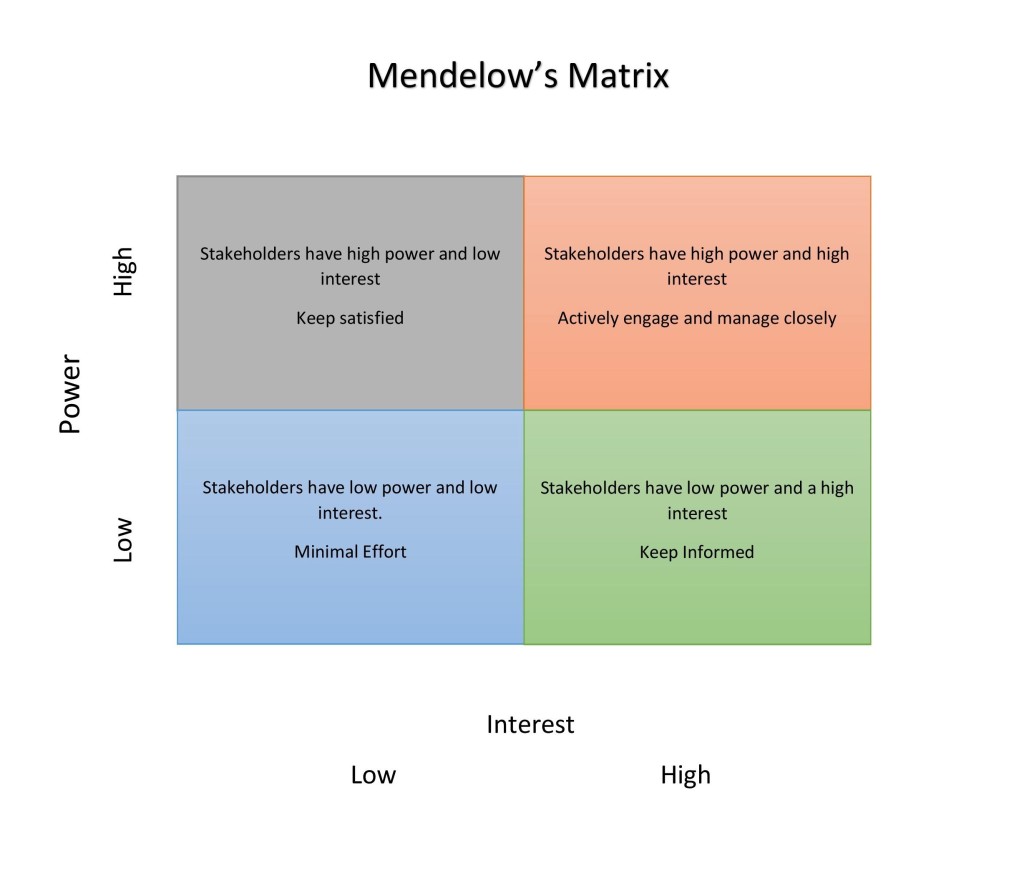
Table of contents
What are stakeholders?
A stakeholder is anyone, whether as an individual or as a collective such as an organisation, that has an interest in or is concerned with the actions of a business to the extent they are affected by those actions or they can influence them.
A business is likely to have numerous stakeholders including directors, shareholders, employees, customers, creditors, regulators, government and the community in which it operates.
Different stakeholders often have different priorities, and that frequently leads to conflict. An employee may want to be paid more, for example, but that may reduce company profits and work against a shareholder’s aim of increasing profits and long-term wealth.
A business therefore needs a way to balance conflicting priorities. Mendelow’s Matrix is a tool used to analyse stakeholders and their attitudes by considering the level of interest a stakeholder has in a project or strategy and whether they are likely to use their power to influence it.
How Mendelow’s Matrix categorises stakeholders
Mendelow’s Matrix consists of four boxes representing stakeholders with high or low interest and high or low power.
High interest and high power stakeholders are key players. A business needs to actively engage them because they are likely to have the most significant influence. They may even be the driver behind the change or strategy, and they may have the power to stop it if they are unhappy.
High interest and low power stakeholders should be kept informed. They care about what is happening, even if they are unlikely to influence change on their own. Even so, they may try to join forces with a group that does have power.
Low interest and high power stakeholders should be kept satisfied. They have the power to influence outcomes and may move into the high-interest group if the strategy starts to affect them more directly.
Low interest and low power stakeholders usually require minimal effort. They are unlikely to show much resistance because they have limited power and limited interest in the strategic direction.
What factors may dictate whether a stakeholder may exercise power?
If a stakeholder has a financial interest, this will increase their level of interest in the company’s operations and future strategy.
An investor may consider their investment to be at risk, or not performing as expected, unless the company produces good annual returns in line with the investor’s initial expectations. Investors with a controlling interest in the organisation are often in the top-right quadrant of Mendelow’s Matrix because they usually have high interest and high power.
An employee may also be considered to have a financial interest even if they have not personally invested capital. Their job is their livelihood, and they may be averse to strategies such as increased automation if those changes place jobs at risk.
Interest also increases when stakeholders do not have easy alternatives. If an organisation supports a local economy, local stakeholders may resist relocation. If a business supplies a product that cannot be obtained elsewhere, customer interest may rise sharply. Likewise, if employees feel they may struggle to find another role quickly, their interest can increase when their employment appears threatened.
If an organisation’s strategy is likely to have a high impact on the community in which it is located, those strategies can generate wider interest and draw attention from stakeholders with the power to influence. Job losses, environmental impact and large process changes are common examples.
Does the stakeholder have the power?
Power is determined by whether the stakeholder can take action that makes an organisation change course in order to keep that stakeholder satisfied.
Employees can strike and withhold their labour, which can be highly disruptive to an organisation and potentially damage its relationships with customers.
Customers can cancel orders if they no longer like, agree with or support a supplier’s strategy.
Banks and other finance providers can call for repayment of overdrafts or loans.
Investors can withdraw their investments, especially if the organisation’s approach to risk is no longer aligned with their own.
FAQ
What is Mendelow’s Matrix used for?
It is used to map stakeholders by power and interest so an organisation can decide how closely each group should be engaged during a project or strategic change.
Why do stakeholder priorities conflict?
Different stakeholder groups want different outcomes. Employees may want higher pay, shareholders may want higher profits, and communities may want local jobs protected.
Can a stakeholder move between quadrants?
Yes. A stakeholder’s interest or power can change as a project evolves, which is why the matrix should be reviewed rather than treated as fixed.